Red-Black Trees: Self-Balancing Without the Chaos
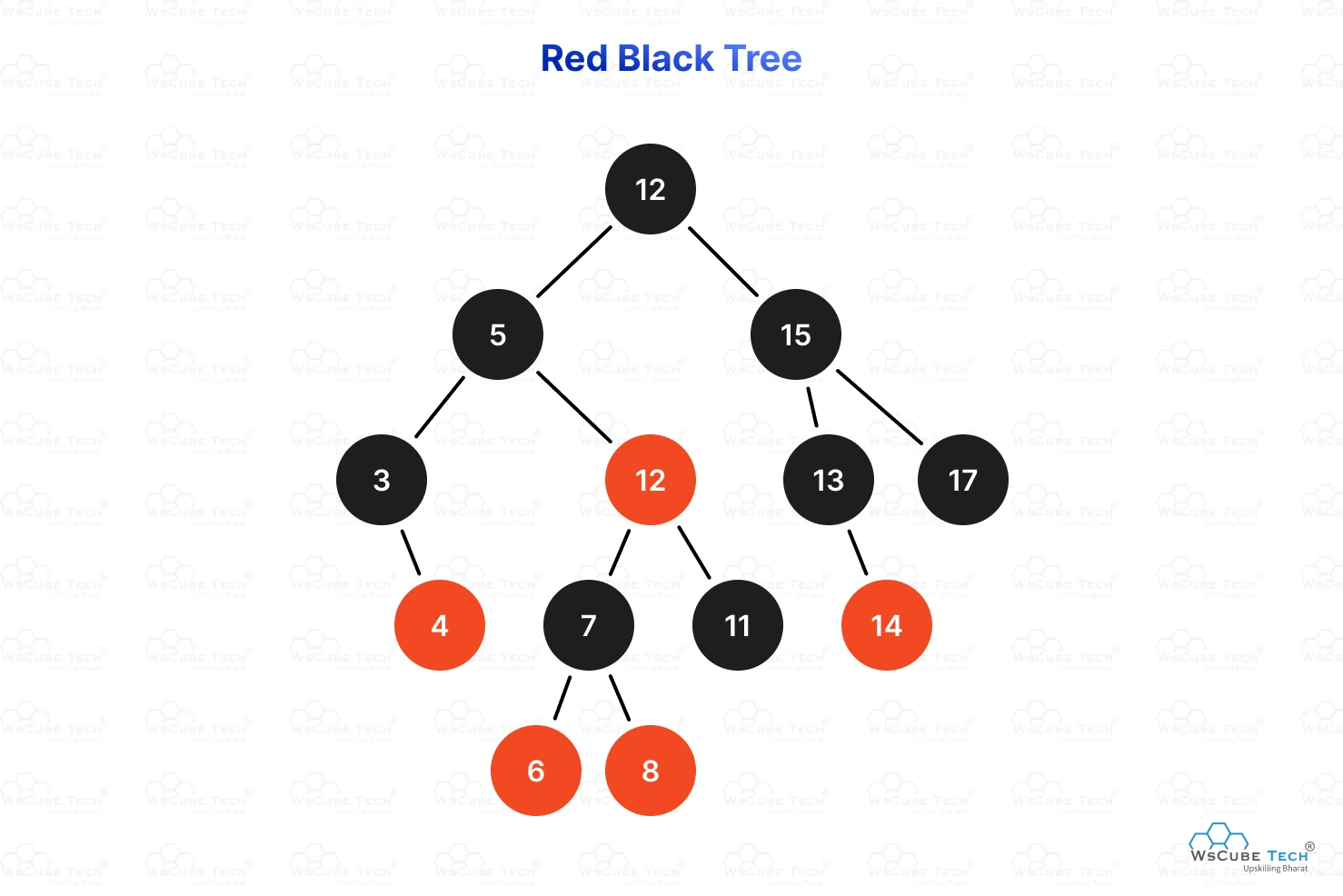
"A red-black tree is a binary search tree where every node is coloured either red or black, and the colouring obeys a set of rules that guarantee the tree stays roughly balanced."
Binary search trees are elegant until they are not. Insert a sorted sequence into a naive BST and you get a linked list — O(n) search, O(n) insertion, all the worst-case behaviour you were trying to avoid. Red-black trees are one solution to this problem, and understanding them teaches you something deeper about how data structures enforce invariants.
The Core Idea
Balance Through Constraints
A red-black tree is a BST with one extra piece of information per node: a colour, either red or black. The colour is meaningless on its own. What matters are the rules that govern it:
- Every node is red or black.
- The root is black.
- Every leaf (null node) is black.
- If a node is red, both its children are black. (No two reds in a row.)
- Every path from a node to any of its descendant leaves contains the same number of black nodes. (The black-height is uniform.)
These rules together guarantee that the longest path from root to any leaf is at most twice the shortest path. That is the balance guarantee, and it is enough to keep operations at O(log n).
Why the Rules Work
The Black-Height Invariant
Rule 5 is the load-bearing constraint. If every root-to-leaf path has the same number of black nodes, the tree cannot become arbitrarily lopsided. The worst case is a path that alternates red and black nodes — but rule 4 prevents two consecutive reds, so that alternating path is at most twice the length of the all-black path.
The tree does not need to be perfectly balanced. It just needs to be balanced enough, and the colour rules enforce exactly that.
Insertion
Fixing Violations After the Fact
Insertion into a red-black tree follows BST insertion, then repairs any rule violations introduced by the new node (which is always coloured red to preserve the black-height of existing paths).
The violations that can occur are limited:
- Uncle is red: Recolour the parent and uncle black, the grandparent red, then recurse upward.
- Uncle is black, new node is an inner child: Rotate to make it an outer child, then fall through to the next case.
- Uncle is black, new node is an outer child: Rotate at the grandparent, swap colours of parent and grandparent. Done.
# Simplified insertion repair (pseudocode)
def fix_insert(tree, node):
    while node.parent.color == RED:
        if uncle(node).color == RED:
            recolor(node)
            node = node.grandparent
        elif is_inner_child(node):
            node = node.parent
            rotate_toward_outer(tree, node)
        else:
            rotate_at_grandparent(tree, node)
            swap_colors(node.parent, node.parent.parent)
    tree.root.color = BLACK
At most two rotations are needed per insertion. The repair propagates upward at most O(log n) steps.
Deletion
The Hard Part
Deletion is more involved than insertion because removing a black node can violate the black-height invariant across an entire subtree. The fix involves a concept called a double-black node — a placeholder that represents a missing unit of black-height — and a case analysis similar to insertion.
The key cases depend on the sibling of the deleted node and the sibling's children. In the worst case, deletion also requires O(log n) recolourings and at most three rotations.
Where Red-Black Trees Appear
Everywhere You Do Not Notice
Red-black trees are not just a textbook exercise:
- `std::map` and `std::set` in C++: Backed by a red-black tree.
- Java's `TreeMap` and `TreeSet`: Red-black tree.
- Linux kernel's completely fair scheduler: Uses a red-black tree to track process run times.
- Python's `sortedcontainers` library: Uses a different structure, but red-black trees motivate why sorted ordered maps exist at all.
Any time you need a data structure that keeps sorted order, supports O(log n) insertion, deletion, and search, and must guarantee worst-case performance, a red-black tree is a natural candidate.
Red-Black vs AVL Trees
The Other Self-Balancing BST
AVL trees are the main alternative. They maintain a stricter balance — the heights of the two subtrees of any node differ by at most one — which gives slightly faster lookups on average.
The trade-off:
- AVL trees: Faster reads, more rotations on writes.
- Red-black trees: Fewer rotations on writes, slightly looser balance, better write performance in practice.
This is why red-black trees dominate in the standard libraries of most languages. Real-world workloads tend to mix reads and writes, and red-black trees handle that mix better.
Conclusion
Red-black trees are worth understanding not because you will implement one from scratch in production, but because the design of them is instructive. They show how a small set of local invariants — a colour rule, a black-height rule — can guarantee a global property: balanced height. That pattern, enforcing global correctness through local constraints, appears throughout computer science. Red-black trees are one of the clearest examples of it.